Updated 19.12.2025
Messengers have long become part of everyday life for every person, regardless of age or profession. With their help, we communicate, share files, make video calls, and solve work-related tasks. There are many services and plenty of features, but when it comes to data protection, questions immediately arise.
Let’s take a closer look at what a “secure messenger” means and which applications in 2025 can be considered reliable.
Security comes first: the role and benefits of a secure messenger
A secure messenger is an application that protects your correspondence. As a result, only the recipient can see the messages. Everything you write or send (text, photos, documents, voice and video messages) is inaccessible to third parties. Even the service through which the correspondence is transmitted has no access to it.
How to choose a secure messenger
It is impossible to say unequivocally which messenger is safe to use. There are many factors that influence the choice of an application. Let’s discuss them in more detail.
End-to-end encryption (E2EE)
End-to-end encryption (E2EE) is a method of protecting messages in which the text is encrypted on the sender’s device and decrypted on the recipient’s device. The service cannot see the content of the correspondence. This means that your conversations remain private and cannot be intercepted or altered by third parties.
Open source code
Messengers with open source code allow independent specialists to study how encryption works, what security measures are used, and what happens inside the service. Such transparency increases the platform’s reliability. You rely not on promises, but on the results of independent audits.
Privacy policy and metadata
Message encryption is an important aspect of privacy protection, but no less important is what data about the correspondence (sending time, IP addresses, contacts, device, etc.) the messenger stores and transmits. Reliable services collect a minimum of such information and store it on secure servers. This reduces the risk of leaks, surveillance, and third-party analysis of correspondence.
Two-factor authentication
Two-factor (multi-factor) authentication is a protection mechanism where a password alone is not enough to log in. Sometimes an additional one-time code from an SMS, application, or hardware key is required. This approach significantly reduces the risk of unauthorized access.
Self-destructing messages
The auto-delete function allows you to set a retention period for correspondence, after which messages are automatically deleted. This is useful for personal data, one-time agreements, and situations where it is important not to leave unnecessary digital traces.
Screenshot blocking
Some messengers implement this feature in secret chats. It helps protect confidential information and prevents unauthorized saving of messages and photos without the user’s consent.
Contact verification (via QR code)
To reduce the risk of man-in-the-middle attacks, messengers offer contact verification. For example, encryption keys can be compared via a QR code. This way, you can be sure that you are actually communicating with the intended person and not a third party.
Why a secure messenger is important for businesses and private users
With the growth of digital threats, a reliable messenger becomes useful for everyone:
- Business — exchanging trade secrets, contracts, and financial reports requires protection against leaks and espionage.
- Personal correspondence — financial transactions, medical data, legal matters that require confidentiality.
- Organizations with increased security requirements — to ensure data does not fall into the wrong hands and correspondence remains under control.
Such solutions are widely used in law enforcement agencies and the military-industrial complex, where data leaks can lead to catastrophic consequences.
The most secure messengers for correspondence in 2025
Which messengers are unsafe for correspondence? To make your search and choice easier, we have prepared a selection of the best solutions from trusted developers.
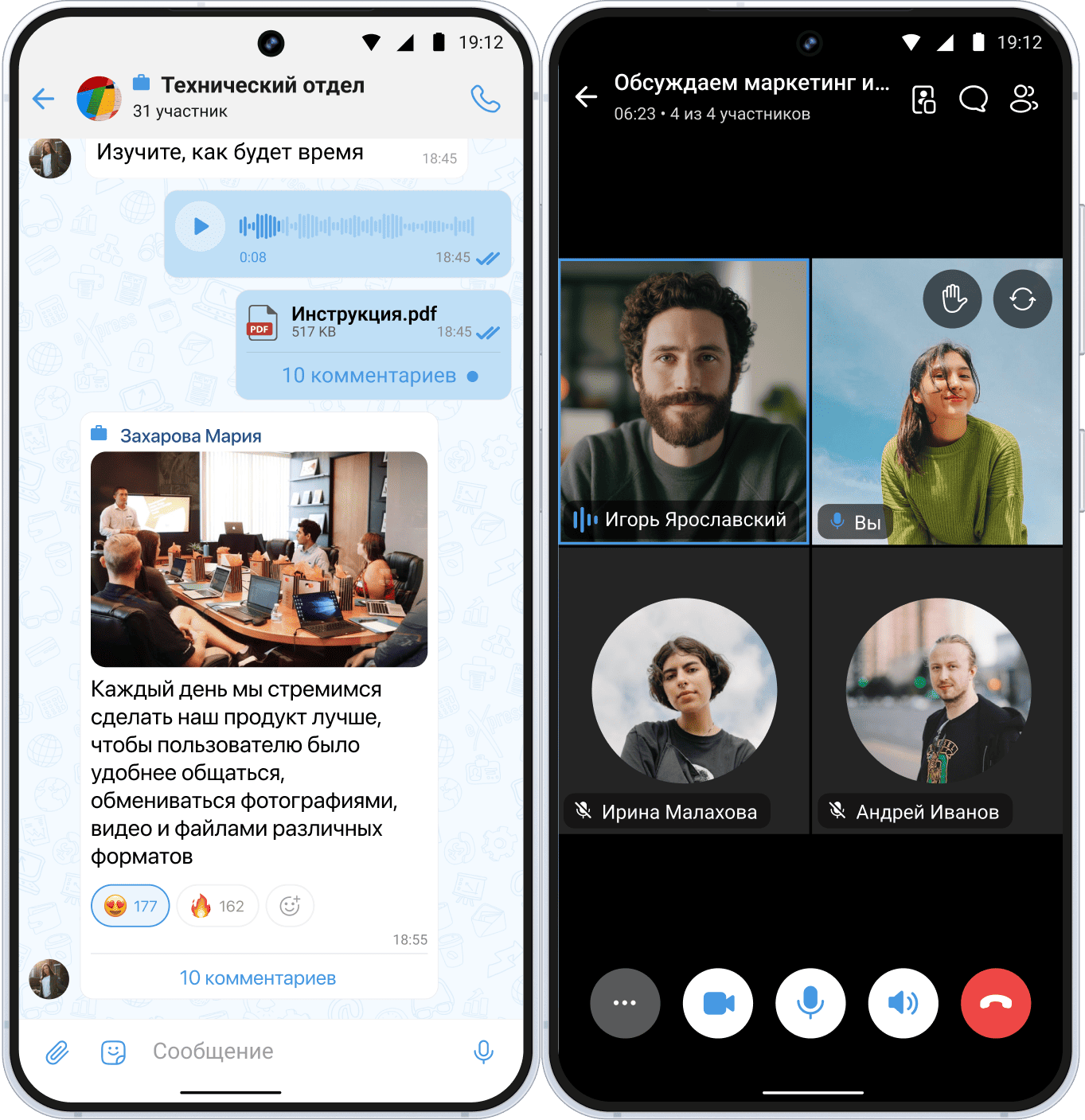
1. eXpress
eXpress stands out among other messengers as it has a certificate from FSTEC of the Russian Federation, confirming its reliability and compliance with high security standards.
One of the main advantages of eXpress is its on-premise servers provided to corporate customers. This means that data and files are stored on the organization’s internal servers.
Authentication through three independent channels provides an additional level of security, ensuring that only properly authorized users can access the messenger. A crypto-container and two layers of elliptic curve data encryption (E2EE) ensure reliable encryption and protection of transmitted information.
One of the unique features of eXpress is the ability to configure access policies to files and data according to specified parameters. For example, you can restrict access to certain files or prohibit their transfer and storage on external media.
eXpress offers an enhanced privacy mode and an automatic deletion timer. In addition, in 2025 this messenger can be used for calls not only with corporate licenses, but also in the public version for all users.
2. Signal
Rightfully considered the gold standard of secure messaging thanks to its robust end-to-end encryption, lack of logging, and commitment to digital privacy principles. This application offers strong encryption and open source code.
One of Signal’s key features is secure end-to-end encryption. An important feature is “Screen Security”, which prevents screenshots of messages and thus unauthorized distribution of your private information. As a result, your conversations remain only between you and your interlocutor. You can also use self-destructing messages.
In addition, Signal not only provides high security but also pays great attention to privacy. It does not track your location and does not collect user data.
3. Wickr Me
This is an instant messaging tool that allows users to communicate securely, as all sent messages disappear without a trace.
Unlike many other messengers, Wickr Me does not require a phone number or email address to create an account. This gives you more freedom and anonymity when using the application.
Although Wickr Me will no longer be available to a wide audience as a consumer product, its evolution as a secure service for business and government opens new perspectives. It will be an excellent choice for organizations and public institutions that value the security and privacy of their communications.
4. Wire
Wire is a messenger that leaves no chance for violators of your privacy.
It uses robust encryption algorithms, has open source code, and even offers a self-destructing messages feature. Moreover, Wire is regularly audited for security to ensure that your data remains reliably protected.
One of Wire’s advantages is its ability to integrate with other popular applications and services. You can easily integrate it with Dropbox, Trello, GitHub, and other platforms, simplifying collaboration with your team.
Wire also offers powerful collaboration features, including document sharing, screen sharing, and group messaging.
5. Threema
This messenger opens up a vast world of communication. You can exchange text messages, voice and video recordings, and transfer large files. Threema also allows you to create polls and broadcasts for easy interaction with your contacts.
One of Threema’s main advantages is its strict compliance with data protection regulations and standards. All user-related information is stored locally on users’ devices. Threema does not log user data and complies with GDPR standards, ensuring maximum privacy.
However, Threema does not offer two-factor authentication and is a paid service. A distinctive feature is the ability to create unique identifiers not linked to personal information, which greatly complicates tracking and identifying the sender.
6. Element
Element is both a secure messenger and a collaboration tool, ideal for group chats. It offers reliable messaging and effective teamwork features, and it is open source.
One drawback is a somewhat outdated interface, but behind this modest appearance lies a powerful privacy protection tool.
Element’s advantages include the use of the Matrix protocol combined with end-to-end encryption. Matrix was designed specifically to ensure user security and confidentiality, adding another layer of protection to your correspondence.
Element is also known for its flexibility and customizability through themes, plugins, and integrations.
7. Session
Session is a decentralized messenger designed to protect metadata where other solutions fall short. On first launch, the user receives a unique Session ID to share with contacts. If the device is changed or the app is reinstalled, a new ID is generated and access to old chats is lost.
Session uses onion routing similar to Tor. Each node sees only part of the route, hiding your IP address and preventing metadata collection. The source code is open for inspection.
Session supports public and private groups, voice messages, and file sharing, with apps available for multiple platforms.
Cons include message delays due to complex routing, a relatively small user base, and no cloud sync, making chat recovery difficult.
8. SimpleX Chat
SimpleX, unlike other platforms, does not use phone numbers or any identifiers. Each person has a separate one-way message queue, making it almost impossible to determine who is communicating with whom.
Messages pass through a network of independent servers chosen by the user. They do not store profiles, contacts, or message content after delivery, keeping communication private.
SimpleX uses end-to-end encryption and Tor to hide your IP address. Features include incognito mode, self-destructing access codes, and disappearing messages.
The downside is that communicating with contacts who use mainstream messengers may be inconvenient.
9 Telegram (secret chats)
Telegram secret chats use end-to-end encryption. Keys are stored only on participants’ devices. Neither Telegram servers nor providers can see message content. Messages are protected by MTProto 2.0 and are not stored in the cloud.
The self-destruct timer allows messages to disappear after a set time. Messages cannot be forwarded, and screenshot attempts are blocked or trigger notifications.
Users can verify encryption keys via unique images. Limitations include one-on-one chats only, no groups, and no desktop synchronization.
10. Messenger MAX
MAX is positioned as a digital ecosystem similar to WeChat. It supports messaging, calls, payments, and mini-applications. Currently available are personal and group chats, media and file sharing up to 4 GB, voice and video calls, reactions, and stickers.
A key feature is support for bots and mini-applications via API, allowing businesses to integrate services directly into MAX. Money transfers via the Faster Payments System are already available, and the list of partner banks will expand.
MAX is included in the domestic software registry and from September 1, 2025 will be preinstalled on new devices, accelerating user growth. However, during the beta stage, the ecosystem remains limited.
Which messenger is the most secure? A choice for protecting company data
Regular messengers are not always suitable for corporate communication. Most of them, except for the Russian eXpress, are developed by foreign companies and store data abroad, which poses risks for official correspondence.
Using public services, it is easy to lose important information: an employee may accidentally send data to the wrong person or use an insecure device. This can lead to data leaks and loss of trust.
It is better to use corporate messengers that store data on their own servers. They protect information and help avoid legal and financial issues.
This is especially important for companies working with customer data, intellectual property, or other critical information. For some Russian organizations and government bodies, the use of foreign messengers is prohibited by law (see Federal Law No. 584-FZ).
Choose a messenger that stores information within the company and complies with legislation to keep corporate data under control.